
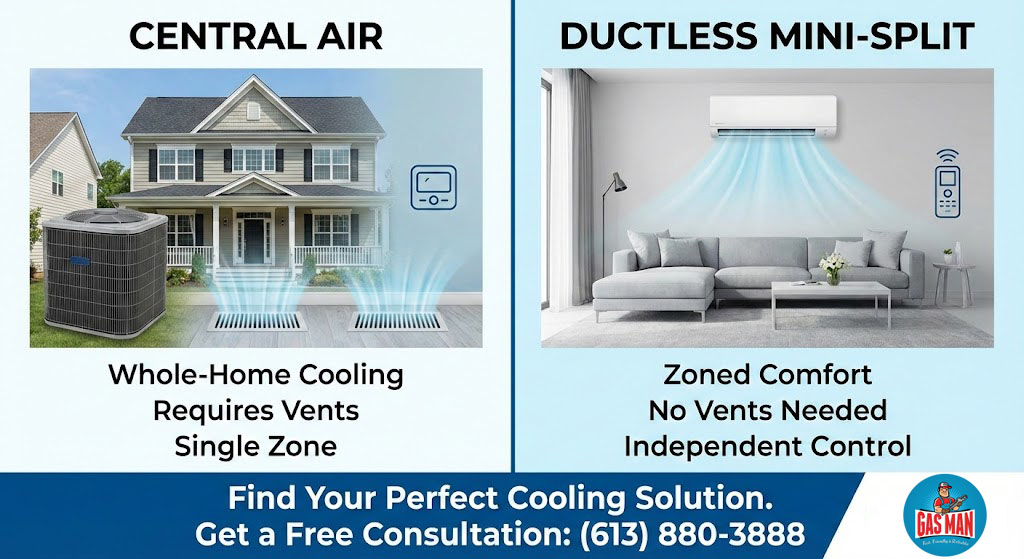
Central Air vs Ductless Mini-Split: Best Cooling for Ottawa Homes
Choosing the right cooling system for your Ottawa home is a significant decision—one that affects your comfort, energy bills, and home value for the next 15-20 years. Two popular options stand out: traditional central air conditioning and ductless mini-split systems.
Both effectively cool your home, but they work differently and suit different situations. This guide compares central air and ductless mini-splits across every factor that matters, helping you make the right choice for your home.
How Each System Works
Understanding the basics helps you see why each system has distinct advantages.
Central Air Conditioning
Central air conditioning is the most common cooling system in Canadian homes. It uses your existing ductwork to distribute cooled air throughout your entire house from a single indoor unit (typically combined with your furnace) and an outdoor compressor.
When you set your thermostat to cool, the system:
- Draws warm air from your home through return ducts
- Passes air over the cold evaporator coil to remove heat and humidity
- Circulates refrigerant to the outdoor unit where heat is expelled
- Distributes cooled air through supply ducts to every room with a vent
The entire home is controlled by a single thermostat, maintaining one temperature setting throughout.
Ductless Mini-Split Systems
Ductless mini-splits consist of an outdoor compressor connected to one or more indoor air-handling units. Each indoor unit is mounted in a specific room or zone and delivers cooled air directly into that space—no ductwork required.
The system works similarly to central air in terms of refrigeration, but instead of distributing air through ducts, each zone has its own unit that:
- Draws in room air and cools it directly
- Allows independent temperature control for that specific zone
- Operates only when needed in that particular space
A single outdoor unit can connect to multiple indoor units (typically 2-8 zones), each controlled separately by remote or wall panel.
Side-by-Side Comparison
| Factor | Central Air | Ductless Mini-Split |
|---|---|---|
| Best For | Homes with existing ductwork | Homes without ducts, additions, zones |
| Installation | Requires ductwork | No ducts needed, less invasive |
| Upfront Cost | Lower (with existing ducts) | Higher per unit, but no duct costs |
| Operating Cost | Moderate | Lower (more efficient, zone control) |
| Efficiency | 14-21 SEER2 | 20-30+ SEER2 |
| Zoning | Single temperature, whole house | Independent control per room |
| Aesthetics | Hidden (only vents visible) | Wall units visible in each room |
| Heating Capability | No (cooling only) | Yes (heat pump models) |
| Lifespan | 12-15 years | 15-20 years |
| Maintenance | Annual + filter changes | More frequent filter cleaning |
Central Air Conditioning: Pros and Cons
Advantages of Central Air
Whole-home cooling from one system: Central air cools your entire house evenly and consistently. Set the thermostat once, and every room with a vent receives cooled air. There’s no need to manage multiple units or zones.
Lower upfront cost (with existing ducts): If your Ottawa home already has ductwork from your furnace, central AC installation is straightforward and typically costs less than outfitting your whole home with mini-splits.
Invisible indoor components: The only visible elements inside your home are unobtrusive vents in floors, walls, or ceilings. The air handler is tucked away in your basement or utility area. This keeps your décor clean and uninterrupted.
Better air filtration: Central systems use larger filters that can capture smaller particles more effectively than mini-split filters. Combined with your ductwork, this can mean better whole-home air quality.
Simple operation: One thermostat controls everything. Most homeowners find this familiar and easy to manage, especially with a smart thermostat.
Familiar to buyers: If you sell your home, central air is the expected standard. Buyers understand it, and appraisers value it accordingly.
Disadvantages of Central Air
Requires ductwork: If your home doesn’t have ducts, installing them is expensive, invasive, and sometimes impossible in older Ottawa homes without major renovation.
Duct losses reduce efficiency: Leaky or poorly insulated ducts can lose 20-30% of cooled air before it reaches living spaces. Even well-maintained ducts have some energy loss.
No zone control: You can’t easily cool only the rooms you’re using. The system cools the entire house whether occupied or not, which wastes energy if you spend most time in certain areas.
Cooling only: Standard central AC provides cooling but not heating. You’ll need a separate heating system (furnace, boiler, or heat pump).
Ductless Mini-Split: Pros and Cons
Advantages of Ductless Mini-Splits
No ductwork needed: Mini-splits are ideal for homes without existing ducts, room additions, converted garages, sunrooms, or any space where running ductwork is impractical or impossible.
Superior energy efficiency: Mini-splits are among the most efficient cooling systems available. With SEER ratings often exceeding 25 (compared to 14-21 for central air), they use significantly less electricity for the same cooling output.
Zone control: Each indoor unit operates independently. Cool only the rooms you’re using, set different temperatures in different areas, and stop wasting energy on empty spaces. This is perfect for households where family members prefer different temperatures.
Heating and cooling in one: Most mini-splits are heat pumps, providing both cooling and efficient heating. In Ottawa’s climate, they can handle most heating needs and serve as a primary or supplemental heat source, reducing reliance on your furnace.
Easier, less invasive installation: Installation requires only a small 3-inch hole through the wall for refrigerant lines—no major construction. Most installations complete in a day.
Longer lifespan: Mini-splits typically last 15-20 years, compared to 12-15 years for central AC units.
Quieter operation: Modern mini-splits operate almost silently, with indoor units producing as little as 19-25 decibels—quieter than a whisper.
Disadvantages of Ductless Mini-Splits
Visible indoor units: Each room needs a wall-mounted, ceiling-mounted, or floor-standing unit. While modern designs are sleek, they’re still visible and may not suit every décor preference.
Higher upfront cost for whole-home coverage: While a single-zone mini-split is affordable, outfitting an entire home with multiple units costs more than central AC (assuming ducts exist). Each additional zone adds cost.
More maintenance per unit: Each indoor unit has its own filter requiring cleaning every 2-4 weeks during heavy use. With multiple units, this adds up to more maintenance tasks.
Aesthetic concerns: Some homeowners don’t like the look of wall units, especially in living rooms or bedrooms. While manufacturers offer various styles, they’re never completely invisible.
Cost Comparison for Ottawa Homes
Central Air Installation Costs
| Scenario | Estimated Cost |
|---|---|
| AC replacement (existing ducts) | $4,000 – $7,500 |
| New AC + ductwork installation | $10,000 – $18,000+ |
| High-efficiency central AC | $6,000 – $9,000 |
Ductless Mini-Split Installation Costs
| Configuration | Estimated Cost |
|---|---|
| Single-zone mini-split | $3,000 – $5,000 |
| Multi-zone (2-3 indoor units) | $6,000 – $12,000 |
| Whole-home (4-5 zones) | $12,000 – $20,000+ |
Key insight: If you have existing ductwork, central air usually costs less upfront. If you need to add ducts, mini-splits often become the more economical choice—and you get zone control as a bonus.
Operating Cost Comparison
Due to higher efficiency and zone control, mini-splits typically cost 20-30% less to operate than central air conditioning. Over the 15-20 year lifespan of the equipment, this can offset the higher initial investment.
Which System Is Right for Your Ottawa Home?
Use these guidelines to determine the best fit for your situation.
Choose Central Air If:
- Your home has existing ductwork in good condition
- You want whole-home cooling with minimal visible equipment
- You prefer single-thermostat simplicity
- Home resale value is a priority
- You already have a furnace and want to share the duct system
- Upfront cost is more important than long-term energy savings
Choose Ductless Mini-Splits If:
- Your home doesn’t have ductwork (older Ottawa homes, conversions)
- You’re adding cooling to a room addition, garage, or sunroom
- You want zone control with different temperatures in different rooms
- Energy efficiency is a top priority
- You want heating and cooling in one system
- Installing ductwork is impractical or too expensive
- You’re supplementing inadequate central air in problem areas
Consider a Hybrid Approach
Many Ottawa homeowners use both systems strategically. For example:
- Central air for the main living areas with existing ducts
- Mini-split for a finished basement, home office, or addition without duct access
- Mini-split to supplement rooms that central air doesn’t cool adequately
Special Considerations for Ottawa’s Climate
Ottawa’s extreme temperature swings create unique considerations.
Summer Cooling Demands
Both systems handle Ottawa summers effectively. Central air provides consistent whole-home cooling, while mini-splits offer the advantage of cooling only occupied spaces during heat waves.
Winter Heating Potential
Mini-split heat pumps can provide efficient heating down to approximately -15°C to -25°C (depending on the model). This covers most Ottawa winter days, though supplemental heating is recommended for the coldest periods.
If you choose a mini-split heat pump, you can potentially reduce furnace usage significantly, lowering heating costs. This dual functionality is a major advantage over cooling-only central AC.
Learn more about heat pump installation options for Ottawa homes.
Humidity Control
Both systems remove humidity effectively. Central air dehumidifies the entire home as it cools. Mini-splits dehumidify each zone independently, which can be advantageous if certain areas (like basements) have higher humidity issues.
Installation Considerations
Central Air Installation
For homes with existing ductwork, central AC installation typically takes one day. The process involves:
- Installing the outdoor condenser unit
- Installing the indoor evaporator coil (usually on your furnace)
- Connecting refrigerant lines
- Wiring electrical connections
- Testing and charging the system
If ductwork modifications are needed, expect additional time and cost.
Mini-Split Installation
Mini-split installation is minimally invasive:
- Mount indoor unit(s) on walls or ceilings
- Drill small holes for refrigerant lines
- Place outdoor unit on a pad or wall bracket
- Connect refrigerant lines and electrical
- Test each zone
Most single-zone installations complete in 4-6 hours. Multi-zone systems may take a full day or two.
Frequently Asked Questions
Can a mini-split cool my whole house?
Yes, with enough indoor units strategically placed. However, for whole-home cooling, this often costs more than central air (if ducts exist). Mini-splits excel for targeted cooling, supplemental cooling, or homes without ductwork.
Are mini-splits as effective as central air?
Yes—often more so. Mini-splits deliver cooled air directly into the room without duct losses, and their higher efficiency ratings mean they use less energy for equivalent cooling.
Do mini-splits work in Ottawa winters?
Modern cold-climate mini-splits operate efficiently down to -25°C or colder. They can provide the majority of your heating, though supplemental heat is recommended for extreme cold snaps.
Which system has better resale value?
Central air is the expected standard in most markets and is valued accordingly by appraisers and buyers. Mini-splits are increasingly accepted but may not add the same perceived value in traditional home sales.
How long do these systems last?
Central air conditioners typically last 12-15 years. Mini-splits often last 15-20 years. Both lifespans assume proper maintenance.
Can I install a mini-split myself?
While some “DIY” mini-splits exist, professional installation is strongly recommended. Refrigerant handling requires certification, and improper installation voids warranties and can damage equipment. Professional installation ensures optimal performance and efficiency.
Make the Right Choice for Your Home
Both central air conditioning and ductless mini-splits are excellent cooling solutions—the right choice depends on your home’s structure, your comfort priorities, and your budget.
If you’re unsure which system suits your Ottawa home best, we’re here to help. Our experienced technicians can assess your home, discuss your needs, and recommend the most effective, efficient solution.
Ready to explore your cooling options? Contact Gas Man Ottawa for a free consultation. We’ll evaluate your home and provide honest recommendations—never pushing equipment you don’t need.
Call us at (613) 880-3888 or request service online to schedule your consultation.