
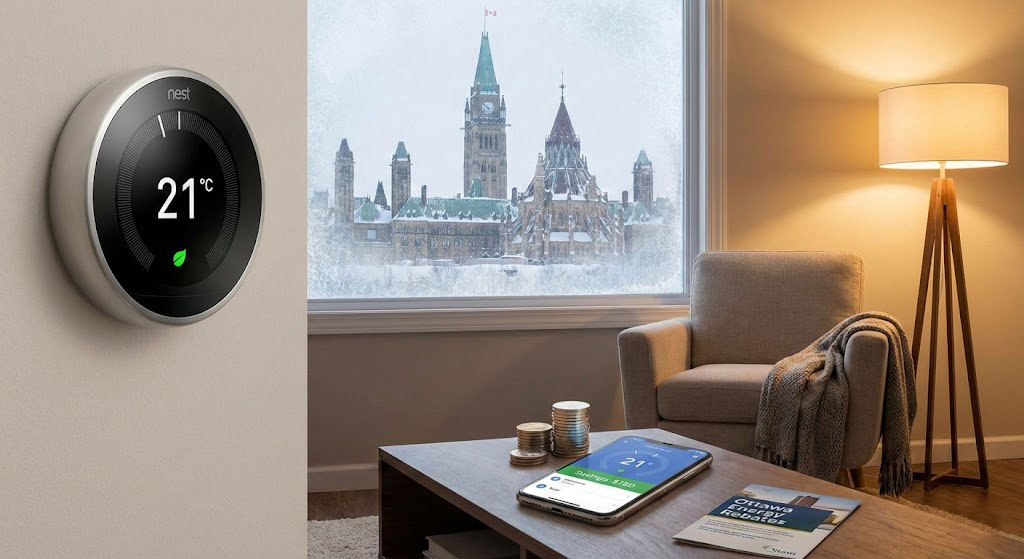
Smart Thermostats for Ottawa: Save Money Year-Round (2026 Guide)
Heating and cooling account for roughly half of your home’s energy costs. In Ottawa’s climate—with frigid winters and increasingly hot summers—that translates to significant money flowing to your utility bills every month.
A smart thermostat is one of the simplest upgrades you can make to reduce those costs while improving comfort. These WiFi-connected devices learn your schedule, adjust temperatures automatically, and give you control from anywhere—all while cutting energy waste.
This guide covers everything Ottawa homeowners need to know about smart thermostats in 2026: how they save money, which features matter most, top brand comparisons, available rebates, and installation considerations.
How Much Can a Smart Thermostat Save?
The savings are real and measurable.
ENERGY STAR reports: Certified smart thermostats save homeowners an average of 8% on heating and cooling bills—approximately $50-$150 annually depending on your home size and energy costs.
Manufacturer claims: Brands like ecobee and Nest report customer savings of 10-23% on heating and cooling costs, potentially $200+ per year for Ottawa homes with significant heating demands.
Research studies: Independent studies show households using smart thermostats with room sensors achieve 14-23% energy reductions by avoiding unnecessary conditioning of unoccupied spaces.
For Ottawa homeowners spending $2,000-$3,000+ annually on heating and cooling, even a conservative 10% savings means $200-$300 back in your pocket each year—quickly recovering the $150-$300 cost of a quality smart thermostat.
How Smart Thermostats Save Energy
Understanding how these devices reduce consumption helps you maximize their benefits.
Learning Your Schedule
Smart thermostats observe when you wake up, leave for work, return home, and go to bed. After about a week, they create a custom schedule that automatically adjusts temperatures—no manual programming required.
The system learns that you don’t need the same temperature at 2 PM on a Tuesday (when no one’s home) as you do at 7 PM when the family gathers. This automatic setback during unoccupied hours is where most savings occur.
Geofencing Technology
Using your smartphone’s location, geofencing detects when you’re leaving home or approaching. The thermostat can automatically switch to energy-saving mode when you leave and begin heating or cooling your home before you arrive.
No more forgetting to adjust the thermostat when you leave—your phone does it for you.
Remote Access
Forgot to turn down the heat before your weekend trip? Adjust it from your phone, anywhere. Unexpected return home on a hot day? Start cooling the house before you arrive.
This flexibility prevents energy waste from temperature settings that don’t match your actual schedule.
Occupancy Sensing
Many smart thermostats include motion sensors that detect whether anyone is home. If the house has been empty for a period, the system automatically enters an energy-saving mode rather than maintaining comfort temperatures for no one.
Room Sensors
Advanced smart thermostats offer remote sensors that you place in different rooms. Instead of measuring temperature only at the thermostat location, the system can average temperatures across multiple rooms or prioritize comfort in the spaces you’re actually using.
This prevents the common problem of one room being comfortable while others are too hot or cold, reducing the tendency to overcool or overheat the whole house to compensate.
Intelligent Optimization
Modern smart thermostats analyze weather forecasts, your home’s thermal characteristics, and your HVAC system’s performance to optimize operation. They learn how long it takes to heat or cool your home and start conditioning at the optimal time to reach your desired temperature when you need it—not earlier than necessary.
Top Smart Thermostat Features for Ottawa Homes
Not all features matter equally for every home. Here’s what Ottawa homeowners should prioritize.
Essential Features
WiFi connectivity: The foundation of smart control. Enables app control, updates, and integration with other devices.
Learning capability: Automatic schedule creation based on your patterns. Reduces the need for manual programming.
Geofencing: Automatic away/home detection using your phone’s location. Prevents forgetting to adjust when leaving.
HVAC compatibility: Verify compatibility with your heating and cooling system before purchasing. Most work with standard systems, but heat pumps, dual-fuel systems, and multi-stage equipment require specific compatibility.
Energy reports: Monthly reports showing usage patterns, runtime, and comparisons help you understand and further optimize your energy consumption.
Valuable Additional Features
Remote room sensors: Critical for homes with uneven temperatures or multiple floors. Sensors measure temperature and occupancy in different rooms, allowing the system to balance comfort or focus on occupied spaces.
Voice control: Integration with Google Assistant, Amazon Alexa, or Apple Siri allows hands-free temperature adjustments.
Air quality monitoring: Some premium models monitor humidity, VOCs (volatile organic compounds), and CO2 levels, alerting you to air quality issues.
Maintenance reminders: Alerts when it’s time to change your furnace filter or schedule HVAC maintenance.
Smart home integration: Works with your broader smart home ecosystem (Google Home, Apple HomeKit, Amazon Alexa, SmartThings).
Top Smart Thermostat Brands Compared (2026)
Three brands dominate the smart thermostat market, each with distinct strengths.
Google Nest
Best for: Ease of use, sleek design, Google Home integration
| Model | Price | Key Features |
|---|---|---|
| Nest Thermostat | $130-$180 | Affordable, easy setup, no C-wire often needed |
| Nest Learning (4th Gen) | $250-$280 | AI learning, large display, Matter compatible |
Pros:
- Iconic, minimalist design looks great on any wall
- Excellent learning algorithm—truly “set and forget”
- Often works without a C-wire (Power Sharing feature)
- Seamless Google Home integration
- Simple, intuitive interface
Cons:
- No Apple HomeKit support
- Room sensors sold separately
- Some reports of issues with multi-stage heat pumps
ecobee
Best for: Multi-room comfort, air quality monitoring, comprehensive features
| Model | Price | Key Features |
|---|---|---|
| ecobee Smart Enhanced | $170-$190 | Room sensor included, excellent interface |
| ecobee Smart Premium | $220-$250 | Air quality monitor, built-in Alexa, premium display |
Pros:
- Room sensors included (more available)
- Excellent multi-room temperature balancing
- Built-in air quality monitoring (Premium model)
- Works with Apple HomeKit, Google Home, and Alexa
- Strong HVAC compatibility, including dual-fuel systems
- Radar occupancy detection
Cons:
- Slightly bulkier design than Nest
- More settings to configure (steeper learning curve)
- Higher price point for premium features
Honeywell Home
Best for: Reliability, HVAC compatibility, value-conscious buyers
| Model | Price | Key Features |
|---|---|---|
| Honeywell T6 Pro | $125-$150 | Broad compatibility, professional-grade reliability |
| Honeywell T9 | $170-$200 | Room sensors, geofencing, Energy Star certified |
Pros:
- Excellent compatibility with complex HVAC systems
- C-wire adapter included with many models
- Proven reliability from established HVAC brand
- Good value for features offered
- Works with Google, Alexa, and Apple HomeKit
Cons:
- Less sleek design compared to Nest
- Learning features not as advanced as competitors
- Interface can feel less modern
Quick Recommendation Guide
| Priority | Best Choice |
|---|---|
| Simplicity and design | Google Nest Learning |
| Multi-room comfort | ecobee Premium or Enhanced |
| HVAC compatibility | Honeywell T9 or T6 Pro |
| Apple HomeKit users | ecobee (any model) |
| Budget-friendly | Honeywell T6 Pro or Nest Thermostat |
| Air quality monitoring | ecobee Premium |
Smart Thermostat Rebates and Incentives (2026)
Several programs can reduce your smart thermostat cost.
Enbridge Gas Rebates
Enbridge offers a $75 rebate for ENERGY STAR certified smart thermostats. This applies to most quality models from Nest, ecobee, and Honeywell.
Utility Programs
Some local utilities offer additional incentives or demand response programs where you earn credits for allowing brief thermostat adjustments during peak demand periods. Check with Hydro Ottawa and Enbridge for current offerings.
Manufacturer Promotions
Watch for seasonal promotions, especially around Black Friday, Boxing Day, and spring HVAC season. Manufacturers and retailers frequently discount smart thermostats by $30-$50.
Combined with Other Upgrades
If you’re upgrading your furnace, air conditioner, or heat pump, many HVAC contractors include smart thermostat installation at a reduced rate as part of the system package.
Installation: DIY vs Professional
DIY Installation
Most smart thermostats are designed for homeowner installation. If you’re comfortable with basic tools and can follow instructions, installation typically takes 30-60 minutes.
DIY is appropriate if:
- You have a standard heating/cooling system
- Your current thermostat has a C-wire (common wire) or your new thermostat doesn’t require one
- You’re comfortable working with low-voltage wiring
- Your system is straightforward (single-stage furnace and AC)
Steps involved:
- Turn off power to your HVAC system
- Remove old thermostat and photograph wiring
- Connect wires to new thermostat base plate
- Mount thermostat and attach faceplate
- Restore power and configure via app
Professional Installation
Consider professional thermostat installation if:
- You have a complex system (heat pump, dual-fuel, multi-stage)
- Your current wiring doesn’t include a C-wire and you’re uncomfortable adding one
- You want to ensure proper configuration for maximum efficiency
- You’re installing as part of a larger HVAC upgrade
Professional installation typically costs $75-$150 and ensures correct wiring, optimal system configuration, and proper integration with your HVAC equipment.
Maximizing Your Smart Thermostat Savings
Simply installing a smart thermostat helps, but these practices maximize your savings.
Use Scheduling Features
Even learning thermostats benefit from initial guidance. Set your typical wake, leave, return, and sleep times to give the system a foundation to optimize.
Enable Geofencing
Ensure location services are enabled on your phone and the thermostat app. This automatic home/away detection prevents heating or cooling an empty house.
Install Room Sensors
If your home has temperature variations between floors or rooms, room sensors help the system maintain comfort where you actually spend time rather than just at the thermostat location.
Review Energy Reports
Check monthly reports to understand your usage patterns. Many homeowners discover opportunities for additional savings they hadn’t considered.
Set Reasonable Temperature Ranges
ENERGY STAR recommends:
- Winter: 20°C when home, 17°C when sleeping or away
- Summer: 25°C when home, 28°C when away
Each degree of setback during winter saves approximately 1-3% on heating costs.
Allow Adequate Setback Time
Your smart thermostat will learn how long your home takes to heat or cool. Trust it—don’t override the schedule because you think it’s starting too late. The system knows your home’s thermal characteristics better than you might guess.
Compatibility Considerations
Before purchasing, verify your smart thermostat will work with your HVAC system.
Common Compatible Systems
- Single-stage gas or oil furnaces
- Single-stage central air conditioning
- Most two-stage furnaces and ACs
- Many heat pumps
Systems Requiring Careful Selection
- Heat pumps with auxiliary heat
- Dual-fuel systems (heat pump + gas furnace)
- Multi-zone systems
- Boilers and radiant heat
- High-voltage systems (240V baseboard heaters)
C-Wire Considerations
Many smart thermostats require a “common” wire (C-wire) to provide continuous power. If your current thermostat doesn’t have one:
- Nest thermostats often work without a C-wire using Power Sharing
- ecobee and Honeywell include power extender kits to work around missing C-wires
- A C-wire can be added professionally if needed
Frequently Asked Questions
How much do smart thermostats cost?
Quality smart thermostats range from $130-$280 depending on brand and features. Budget options exist around $80-$100, while premium models with room sensors and air quality monitoring reach $250+.
Will a smart thermostat work with my old furnace?
Most smart thermostats work with furnaces regardless of age, as long as the furnace uses standard 24V control wiring. Very old systems or unusual configurations may require verification. Check the manufacturer’s compatibility tool before purchasing.
Do I need WiFi for a smart thermostat?
Yes, WiFi is required for app control, learning features, and software updates. Without WiFi, the thermostat still functions but loses most “smart” capabilities.
Can a smart thermostat really learn my schedule?
Yes. Modern learning thermostats (especially Nest and ecobee) observe your temperature adjustments and presence patterns, creating automated schedules within about a week. The more consistently you live, the better they learn.
What if I have radiant floor heating?
Some smart thermostats work with radiant systems, but compatibility is more limited. Verify before purchasing, and consider models specifically designed for radiant heat.
Are smart thermostats worth it in Ottawa?
Absolutely. Ottawa’s extreme temperatures—both winter heating and summer cooling—mean your HVAC system runs extensively. The 8-23% savings smart thermostats provide translate to $150-$500+ annual savings for many Ottawa households, making payback periods as short as 6-18 months.
Start Saving with a Smart Thermostat
A smart thermostat is one of the highest-return home improvements you can make. For a modest investment of $150-$250, you gain better comfort control, convenience, and ongoing energy savings that pay back the cost within a year or two.
Whether you choose Nest’s elegant simplicity, ecobee’s comprehensive features, or Honeywell’s reliable value, upgrading to a smart thermostat is a smart decision for any Ottawa home.
Ready to upgrade your thermostat? Contact Gas Man Ottawa for professional installation and ensure your smart thermostat is configured optimally for your HVAC system.
Call us at (613) 880-3888 or request service online to schedule your smart thermostat installation.